
Close the readiness gap
Every TA function is under pressure to deliver value from AI. Our AI Advance program is the difference between a strategy that gets results and a pilot that quietly goes nowhere.
It's powered by The Recruiting Future Knowledge Hub©, a searchable archive of every interview and insight from 800+ podcast episodes. Combined with my three decades of experience in TA technology, it means the framework is built on what's actually working inside enterprise TA functions, not on theory.
At the centre of AI Advance is the AI Readiness Framework, a model that helps TA leaders get full value from AI. Book a call to find out where your function stands and where to start.
A 30-minute discovery call about what working together could look like.
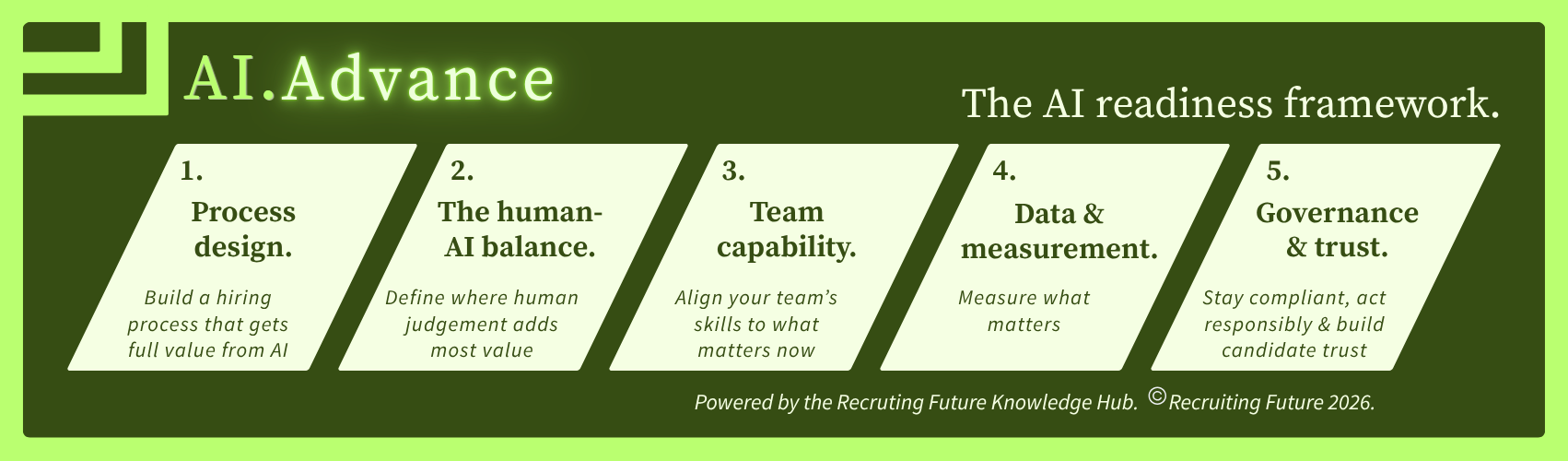
The AI Readiness Framework
Priority 1
Process Design
Build a hiring process that gets full value from AI
Most TA functions are applying AI to processes that were never deliberately designed. AI applied to a badly designed screening process doesn't produce better hiring. It produces faster bad hiring. The organisations seeing real returns from AI are the ones that asked the harder question first: which of our processes are actually worth accelerating, and which need rebuilding before AI goes anywhere near them?
Priority 2
The Human-AI Balance
Define where human judgement adds most value
For each stage of the hiring process, you need to define which decisions benefit from AI and which demand human judgement. Most organisations haven't done this deliberately, and the boundary is being set by default rather than by design. The longer that continues, the harder it gets to unpick. The TA functions getting this right are drawing these lines now, while they still have the room to shape how AI and their teams work together.
Priority 3
Team Capability
Align your team's skills to what matters now
The skills your team were hired for are not the skills they need going forward. As AI takes on more of the process, the recruiter's value shifts to advisory, stakeholder consulting, candidate experience design, data interpretation, and relationship depth. This shift is already underway. The question is whether you're developing your team's capabilities around it, or whether it's happening to them.
Priority 4
Data and Measurement
Measure what matters
AI amplifies whatever you measure. If your metrics don't reflect what the business actually values, AI will optimise in the wrong direction. As AI transforms how entire organisations operate, TA will face sharper scrutiny on its strategic contribution. The functions that have aligned measurement to business outcomes now will be the ones that can make that case when it counts.
Priority 5
Governance and Trust
Stay compliant, act responsibly, and build candidate trust
Recruitment AI is increasingly subject to regulation, and the rules are still being written. But beyond compliance, there is a trust question that most functions haven't addressed yet. Candidates already distrust AI in hiring. Every month you deploy AI without a clear governance framework and a transparency story candidates can see, you're accumulating risk to the employer brand and candidate relationships your team has worked to build.
Get these five priorities right and AI makes your hiring better, not just faster. Your team spends its time where human judgement matters most, and you get results that prove TA's value to the business.
The TA functions getting AI right are pulling ahead fast. Through AI Advance I offer team workshops and one-to-one advisory built on the framework. Book a call and we can talk about which fits your organization.
A 30-minute discovery call about what working together could look like.